


Non-Surgical Procedures Bill (Scotland)
Keeping the Community Updated on Developments in Skin Treatment Regulations
THE BILL
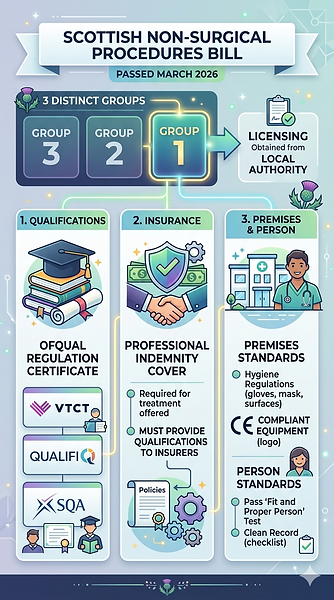
The Scottish Non-Surgical Procedures Bill has been passed (March 2026) and became an Act of Law on May 12th 2026. Business will have until 2027 to become licensed.
Group 1 covers treatments listed overleaf and will be administered by Local Authorities. Treatments will have to be undertaken by a licensed practitioner in licensed premises.
Authorities will consider applications based on 3 main criteria - Qualifications - does the practitioner have an Ofqual regulated certificate in the treatment
Insurance - does the business have professional Indemnity Insurance cover for the treatment concerned. To get insurance cover the practitioners will require to have Ofqual certification.
Premises & Person - Does the premises pass the required hygiene requirements. Is the equipment used CE compliant. Are the business owner and practitioners Fit & Proper.
*Ofqual regulate awards bodies such as VTCT, Qualifi and SQA to deliver appropriate courses through schools like Erasure Skin Academy in Glasgow
GROUP 1
The Government has determined that treatments which break the skin or impart energy via heat, cold, laser, electricity, sound, chemicals or medicines may fall under Group 1 restrictions.
These treatments are considered significantly risky and therefore can be in Group 1. They do NOT require a Health Improvement Scotland (HIS) regulation and/or medical supervision so are not in Group 2 or 3.
Treatments such as Massage, Make-up, nail treatments and hair treatments are low risk and do not require licensing. Microneedling up to 1.5mm depth will be within Group 1 with deeper treatments being in Groups 2 or 3. Similarly, Chemical Peels that penetrate deeper that the Epidermis will be in Group 2 or 3.
Lasers that are Ablative are outside Group1 but Laser hair removal and tattoo removal remain in Group 1.
The Scottish Government has applied these restrictions to improve client safety, reduce complications.
It is not currently clear why aromatherapy or hair dyes are not included in the chemicals category.


ARE YOU AFFECTED?
Anyone who delivers the Group 1 listed treatments will be required to conform to the regulations and get licensed, insured and checked. This means if you are working from a Salon, Hairdressers, Clinic, Barbers, Spa, work from home, Garden room or are mobile you will be need to follow the Group 1 treatments rules.
As mentioned the premises need to have the environmental health requirements, so having suitable hot water and washing facilities, fire safety features, COSHH, Health & Safety. In addition each practitioner who delivers a particular treatment needs to have their own practitioners license, one does not cover all.
For those who provide treatments in multiple locations, perhaps at different salons or are mobile, will need to have a full license for each local authority you work in.
WHAT SHOULD YOU DO?
1. PLAN - Check you qualifications; CPD, manufacturers training or unregulated qualifications should be upskilled to Ofqual regulated certification.
2. PLAN - Limited regulated training organisations in Scotland is resulting in few places available. Identify a suitable School/Academy and get enroled on a progression route that suits your individual training requirements to meet your personal goals.
3. PLAN - Local Authorities will be under pressure to meet demands of new and existing businesses: answering enquiries, processing applications, reviewing appeals, carrying out premises reviews. Resources are limited so best make early contact, get on their radar to make things as smooth as possible.
4. PLAN - Insurance companies and regulatory bodies require documentation for treatment protocols, risk assessments, Client Consultations and PAT testing etc. Ensure yours are up to date.
5. PLAN - Seek confirmation from your insurance company about what qualifications they require to maintain cover. They are largely English based and will default to English rules so should be reminded that you require coverage in Scotland.
6. PLAN - Equipment that has been purchased or acquired to deliver treatments must meet compliance, health & safety, environmental and other standards. This is signified with a CE mark on the device. A register should be maintained with images of serial numbers, CE marks and annual PAT testing compliance.


WHY COMPLY?
Local Authorities may see this as an opportunity to plug financial gaps and so will be motivated to ensure all businesses in their area conform. With the additional expense incurred to comply whistleblowing is likely on those trying to evade regulation.
Local Authority Environmental Enforcement Officers have the authority to access premises to investigate issues like potential lapses or missing licenses. They can request to examine equipment and records and review hygiene standards and practices.
Failure to have the appropriate licenses or substandard hygiene can result in fines up to £5000 for every issue, meaning providing say 3 treatments without the correct qualification could result in a £15000 fine.
Equipment that doesn’t meet the required standards can be confiscated and in certain circumstances businesses can be closed down.